
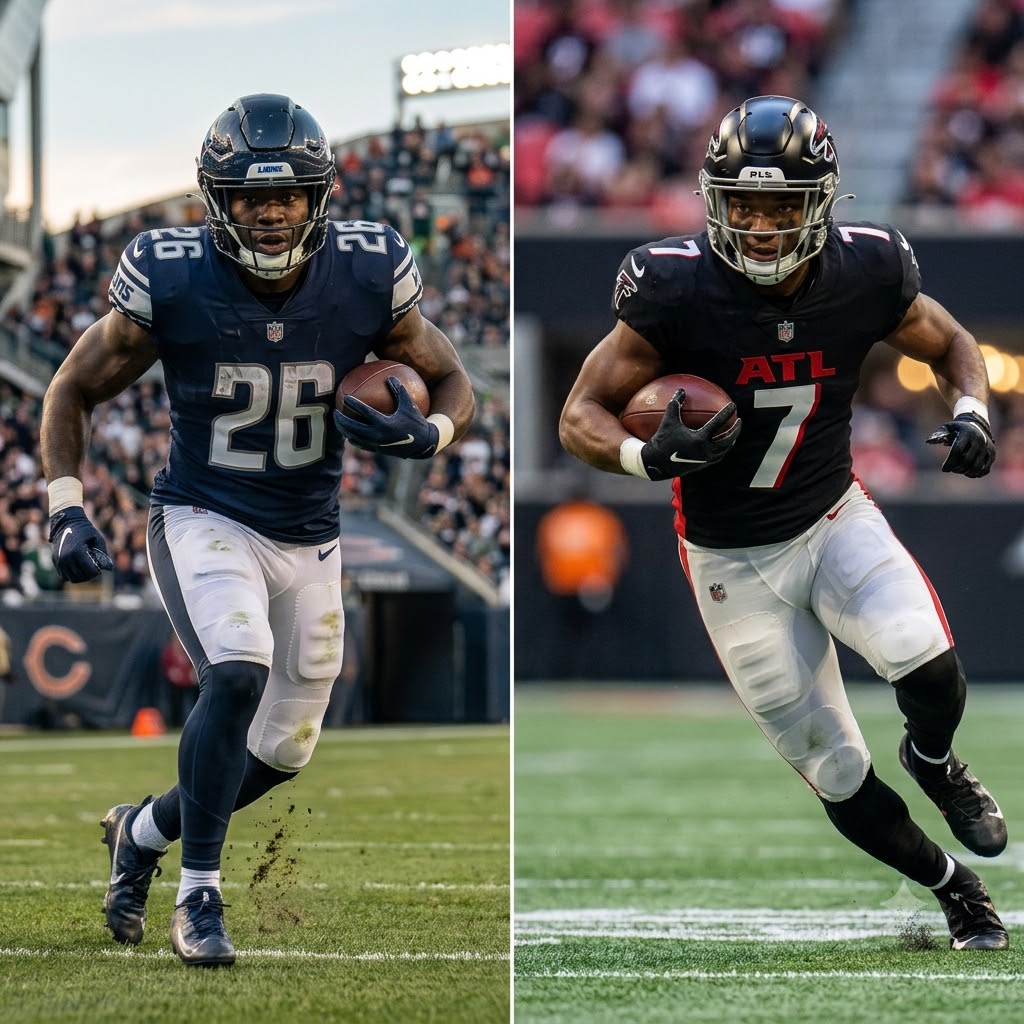
Every summer, the NFL contract machine starts humming, and every summer, running backs find themselves on the wrong side of a spreadsheet. Look around training camps right now. Bijan Robinson and Jahmyr Gibbs are conducting subtle hold-ins, seeking extensions that reflect their status as focal points of their respective offenses. Meanwhile, Jonathan Taylor is working through another round of contract negotiations in Indianapolis.
The conventional wisdom has been pounded into our heads by cap analysts for a decade: Don't pay running backs. The argument is simple—the position is high-risk, easily replaceable, and dependent on offensive line play.
While I agree that paying mid-tier runners $10 million a year is a fast track to salary-cap hell, the "never pay a back" dogma has swung too far. When you are dealing with the elite 1% of backfield talent, top-dollar money isn't an overpay—it’s the price of admission for a truly dominant offense.
If you want proof of what a game-changing back does for a football team, look at what happens when a superstar changes zip codes.
When the New York Giants let Saquon Barkley walk, they didn't just lose a runner; they lost the entire structural integrity of their offense. Without Barkley to draw heavy boxes and bail out erratic quarterback play, New York’s scoring efficiency cratered. Meanwhile, across the division in Philadelphia, Barkley exploded for a historic 2,000-yard campaign, powering the Eagles straight to a Super Bowl victory. He didn't just meet the expectations of his contract—he elevated every single player around him.
We saw the exact same dynamic when Christian McCaffrey was traded from Carolina to San Francisco. Overnight, Kyle Shanahan’s scheme transformed from a clever, timing-based system into an unstoppable juggernaut. On the flip side, look at Baltimore after adding Derrick Henry. Henry didn't need to catch 80 passes to justify his price tag—his sheer physical presence gave the Ravens the league's top-ranked offense.
When you let a generational back walk, your offense falls off a cliff. When you bring one in, your team's ceiling changes overnight.
To understand why paying a top-tier running back makes sense, you have to look at the exploding receiver market. Top-flight wideouts like Justin Jefferson, Ja'Marr Chase, and Jaxon Smith-Njigba are now clearing $35 million to $40+ million annually. Even second-tier receivers are routinely signing deals north of $25 million per year.
Now look at the elite running back market:
- Saquon Barkley: ~$20.6M AAV
- Christian McCaffrey: ~$19M AAV
- De'Von Achane & Breece Hall: ~$15M–$16M AAV
Consider what a true elite back gives you for that price: Running: 1,200+ yards on the ground to stay ahead of the chains. Pass Catching: 50 to 80 receptions out of the backfield, acting as an extension of the short passing game and a safety valve against the blitz. Pass Protection: Picking up free-releasing linebackers and blitzing safeties to keep your $50M quarterback healthy.
Paying a wide receiver $38 million to run routes on 60 snaps a night is considered good business, but paying an all-pro back $18 million to touch the ball on every third play is labeled reckless? The math simply doesn't add up.
The hidden value of an elite running back lies in how they dictate defensive behavior.
When a defense lines up against a back like Derrick Henry, Bijan Robinson, or Saquon Barkley, they cannot play light, shell coverages. They are forced to drop an extra safety into the box, changing their defensive alignment before the ball is even snapped.When a quarterback fakes a handoff to a tier-one running back, linebackers and safeties pause for a split second because the cost of guessing wrong is a 60-yard house call. That split second creates massive passing lanes in the intermediate field. It makes life infinitely easier for your offensive line, gives your quarterback clear pre-snap reads, and opens up 1-on-1 matchups for those expensive wide receivers downfield.
No one is suggesting teams should hand out $12 million contracts to replacement-level runners who average 3.8 yards per carry behind elite blocking. The analytics community was right about that tier of player.
However, applying that logic to dynamic playmakers who tilt the field is a major strategic mistake. A elite running back is an offensive multiplier—a piece that makes the quarterback better, protects the passing game, and dictates terms to the defense. At half the price of a top wide receiver, paying a superstar back isn't bad cap management. It's one of the best bargains left in modern professional football. No can we just pay these guys and get back to the football!