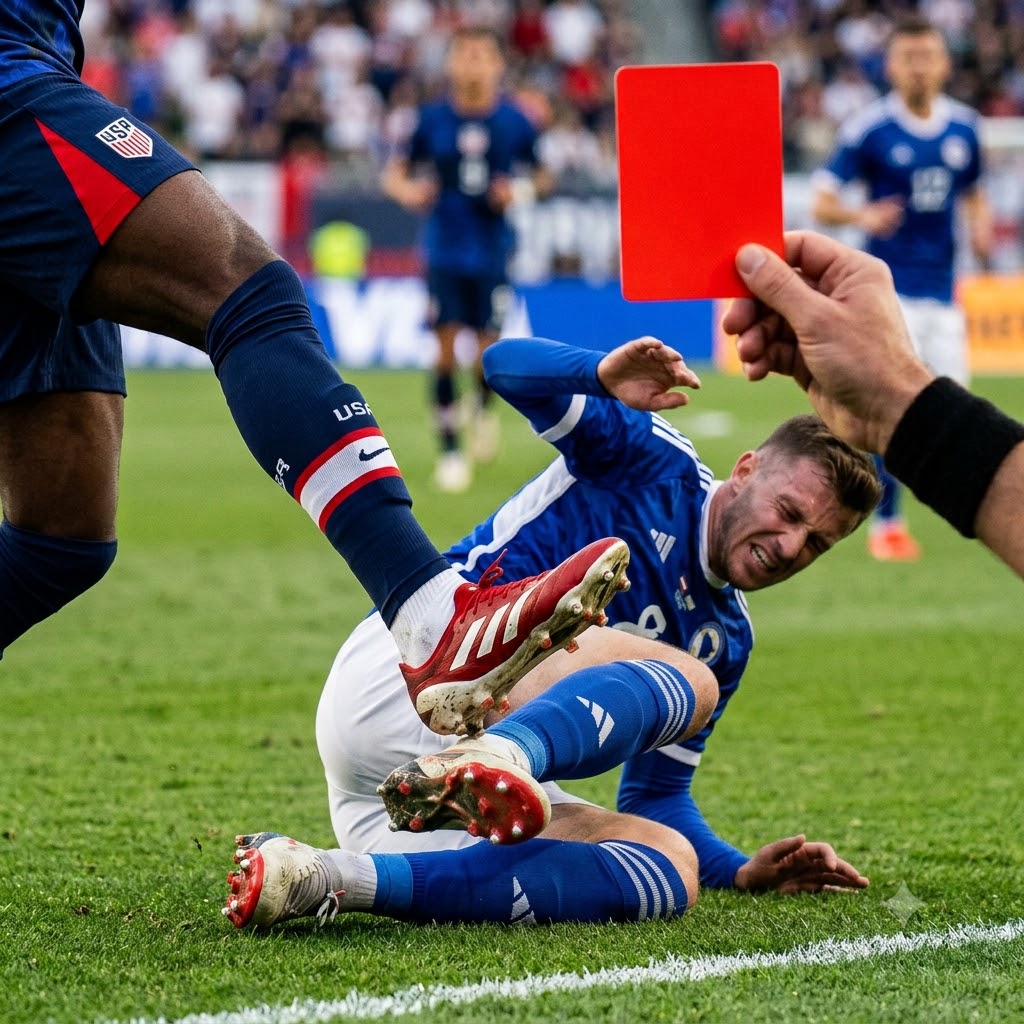
The beautiful game often hinges on a single moment, but in international soccer, those moments are increasingly being viewed through a heavily distorted lens. During the United States’ recent Round of 32 match against Bosnia and Herzegovina, a 64th-minute sequence turned what should have been an ordinary footballing collision into a tournament-altering disaster. U.S. forward Folarin Balogun was shown a straight red card, igniting a fierce global debate about player safety, the letter of the law, and the dangerous direction modern officiating is heading.The play itself unfolded in a flash. Balogun was battling shoulder-to-shoulder with Bosnian center-back Tarik Muharemovic. As the two physically engaged, Balogun was knocked off balance, his body weight shifting as he began to fall toward the pitch. In a completely natural, involuntary physical reaction, Balogun extended his leg downward to catch his fall. Simultaneously, Muharemovic was sliding in to clear the ball. As a result of the collision and the stumble, Balogun’s foot planted directly onto the Bosnian defender’s ankle. The referee on the pitch, Raphael Claus, initially let play continue without showing a card. It was only after a prompt from the Video Assistant Referee (VAR) booth that Claus walked over to the pitchside monitor, viewed a series of slowed-down replays, and returned to brandish a straight red card for serious foul play. To understand why the VAR room intervened, one has to look at the strict, literal phrasing of FIFA’s Law 12 regarding "Serious Foul Play." By the book, a tackle or challenge that "endangers the safety of an opponent" or uses "excessive force or brutality" must be sanctioned with a red card. The most crucial element of this rule is what it doesn't say: it completely ignores intent. Under the current refereeing guidelines, it does not matter if a player slips, loses their balance, or is actively trying to avoid contact. The VAR officials and Referee Claus focused entirely on the objective consequence of the action. The freeze-frame showed metal studs making direct contact with a player’s exposed ankle above the boot line, causing the joint to twist painfully. In the eyes of a referee literalist, an accidental stamp is identical to a malicious one if the threat of injury is the same. Under that rigid interpretation, the red card was justified.Despite the "by the book" defense, the overwhelming majority of the soccer community—coaches, former referees, and analysts alike—unanimously decried the decision as a massive mistake. U.S. manager Mauricio Pochettino led the charge post-match, pointing out the absurdity of punishing a natural loss of balance."It never was intentional... It’s never a red card. Never," Pochettino stated bluntly. "It was a normal action in football that you are fighting for the ball and your feet land."Former Premier League and FIFA referee Mark Clattenburg, acting as a rules analyst for FOX Sports, strongly criticized the VAR intervention. Clattenburg argued that by slowing the footage down to a crawl and showing the referee a static image of studs on skin, the VAR booth stripped away all the necessary context. In real-time, the challenge lacked the speed, malice, or force required to meet the "excessive force" threshold. It was a footballing accident, not a violent assault. Agreeing with the majority of the soccer community, this red card feels entirely excessive and fundamentally detached from the reality of playing sports. When rules become completely black-and-white based purely on the physical outcome of an incident, we enter a incredibly slippery slope. Soccer is a high-speed, contact sport where players are constantly knocked off balance, tripped, and forced to react mechanically to gravity. If intent—or at the very least, a player's lack of control or recklessness—is completely removed from the equation, then nearly every accidental collision that results in an unfortunate landing or an injury could theoretically be deemed a red card. If a defender is pushed into a forward and inadvertently steps on them while trying to stay upright, is that a red card too? Referees must be given the flexibility to distinguish between a malicious challenge and a mechanical accident. Otherwise, the integrity of the game is compromised.The most frustrating aspect of this entire debacle is that the call was entirely a product of technology. In real-time, no human being watching the game thought a red card offense had occurred; the referee didn't even deem it worth a yellow in motion. It was only when viewed via a microscopic, slowed-down video review that it was manufactured into a sending-off. To compound the injustice, tournament rules offer no way out. According to the FIFA Disciplinary Code, a direct red card incurs an automatic one-match suspension with absolutely no mechanism for a team to appeal a subjective judgment call. Appeals are strictly limited to administrative blunders, such as cases of mistaken identity.Because a technology-driven, deeply flawed decision cannot be corrected, the USMNT will be forced to play their massive Round of 16 knockout match against Belgium without their leading goalscorer. It is a stark reminder that while VAR was introduced to correct "clear and obvious errors," it is increasingly being used to create them.
International FB
The Freeze-Frame Trap: Why the World Cup’s Latest Red Card Exposes a Flaw in the Rules
A World Cup shocker! 🚨 Folarin Balogun’s controversial VAR red card vs. Bosnia has ignited a global debate. Was it a dangerous tackle or a total accident? We dive into Law 12, the "slow-mo trap," and the slippery slope of removing intent.

Ryan A