
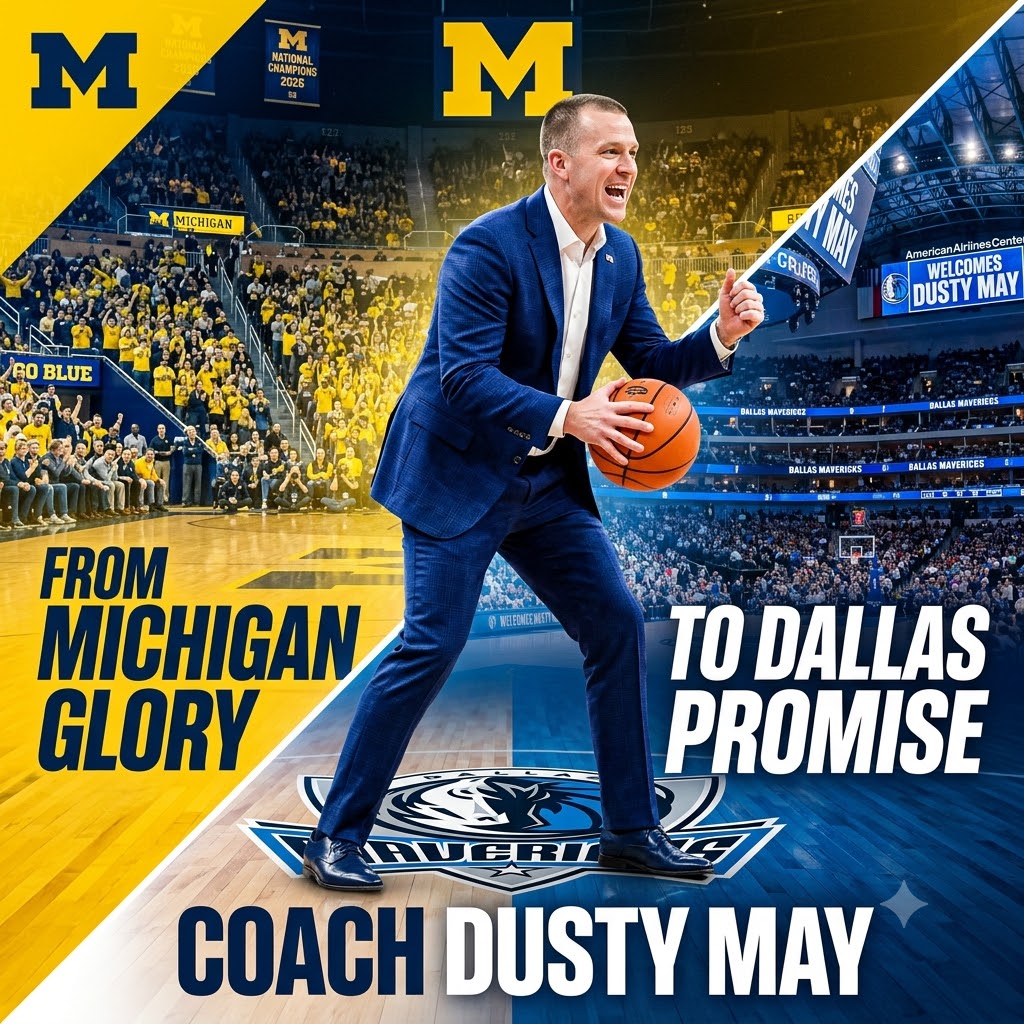
The Dallas Mavericks have officially sent shockwaves through both the college and professional basketball landscapes. In a stunning power move, President Masai Ujiri and General Manager Mike Schmitz have pulled head coach Dusty May away from the Michigan Wolverines to lead the Mavericks into a brand-new era. Following a turbulent 26-56 season and a mutual parting of ways with Jason Kidd, Dallas didn't just look for a quick fix; they opted for a complete structural and cultural transformation. What makes May the hottest coaching commodity in the sport isn't just that he wins; it’s how he builds. May arrives in Dallas fresh off a historic, fairy-tale run in Ann Arbor where he orchestrated a dramatic turnaround, leading the Wolverines to a staggering 37-3 record and the 2026 NCAA National Championship. Before that, he put himself on the map by taking mid-major Florida Atlantic University to its first-ever Final Four in 2023. The Mavericks’ front office was acutely attracted to this history of maximizing talent. With reigning NBA Rookie of the Year Cooper Flagg serving as the absolute centerpiece of the franchise’s future, Dallas targeted an elite developer who could connect with and shepherd a 19-year-old superstar. Furthermore, May’s modern, pro-style pedigree—heavy on transition offense, continuous ball movement, and defensive versatility—impressed draft prospects and scouts alike. Combined with a measured, collaborative demeanor that stands in stark contrast to more volatile, old-school bench bosses, May fit the exact executive blueprint Ujiri and Schmitz demanded.Despite his impeccable resume, history dictates that May is stepping into an incredibly treacherous arena. Jumping directly from a college campus to an NBA sideline is historically one of the most perilous leaps a coach can make. The graveyard of college legends who crumbled under the weight of the pro game is vast, primarily because the absolute authority required to command teenagers does not translate to managing multi-millionaire professional athletes.- John Beilein (2019):
In an ironic twist, May’s predecessor at Michigan made the exact same jump to the Cleveland Cavaliers. A brilliant tactical mind, Beilein’s rigid, fundamentals-driven, textbook teaching style completely alienated his players. He lasted just 54 games before resigning mid-season.
- Rick Pitino (1997):
Armed with supreme roster control and a massive contract with the Boston Celtics, Pitino tried to implement his signature full-court press. Professional athletes routinely sliced it to pieces, leading to years of frustration and his infamous "Larry Bird is not walking through that door" press conference.
- John Calipari (1996):
After dominant success at UMass, Calipari took his hyper-controlling nature to the New Jersey Nets. He survived just over two seasons before being fired after a 3-17 start, quickly retreating to the college ranks where he could maintain total control over his rosters.Even modern successes like Brad Stevens and Billy Donovan required years of adjustment, moving away from rigid collegiate systems to treat their players as corporate partners rather than pupils.If there is a golden light at the end of this tunnel, it belongs to Larry Brown. Brown remains the ultimate outlier. The lone coach in basketball history to win both an NCAA national championship (with Kansas in 1988) and an NBA title (with the Detroit Pistons in 2004).The Mavericks are banking heavily on the idea that Dusty May can be the next great anomaly. Crucially, May isn’t entering the league from the college environment of twenty years ago. The modern NCAA landscape—defined by NIL deals, the immediate transfer portal, and transient rosters—functions very much like a pseudo-professional league. May has already spent the last few years managing complex financial egos, roster turnover, and intense media scrutiny.With the NBA Draft arriving tomorrow and Dallas holding the No. 9 and No. 30 overall picks, May has no time for a learning curve. He goes straight from celebrating a college national championship to a professional war room. History says the odds are stacked against him, but if his track record of shattering ceilings holds true, Dallas may have just found the perfect architect for their future.
In an ironic twist, May’s predecessor at Michigan made the exact same jump to the Cleveland Cavaliers. A brilliant tactical mind, Beilein’s rigid, fundamentals-driven, textbook teaching style completely alienated his players. He lasted just 54 games before resigning mid-season.
- Rick Pitino (1997):
Armed with supreme roster control and a massive contract with the Boston Celtics, Pitino tried to implement his signature full-court press. Professional athletes routinely sliced it to pieces, leading to years of frustration and his infamous "Larry Bird is not walking through that door" press conference.
- John Calipari (1996):
After dominant success at UMass, Calipari took his hyper-controlling nature to the New Jersey Nets. He survived just over two seasons before being fired after a 3-17 start, quickly retreating to the college ranks where he could maintain total control over his rosters.Even modern successes like Brad Stevens and Billy Donovan required years of adjustment, moving away from rigid collegiate systems to treat their players as corporate partners rather than pupils.If there is a golden light at the end of this tunnel, it belongs to Larry Brown. Brown remains the ultimate outlier. The lone coach in basketball history to win both an NCAA national championship (with Kansas in 1988) and an NBA title (with the Detroit Pistons in 2004).The Mavericks are banking heavily on the idea that Dusty May can be the next great anomaly. Crucially, May isn’t entering the league from the college environment of twenty years ago. The modern NCAA landscape—defined by NIL deals, the immediate transfer portal, and transient rosters—functions very much like a pseudo-professional league. May has already spent the last few years managing complex financial egos, roster turnover, and intense media scrutiny.With the NBA Draft arriving tomorrow and Dallas holding the No. 9 and No. 30 overall picks, May has no time for a learning curve. He goes straight from celebrating a college national championship to a professional war room. History says the odds are stacked against him, but if his track record of shattering ceilings holds true, Dallas may have just found the perfect architect for their future.