
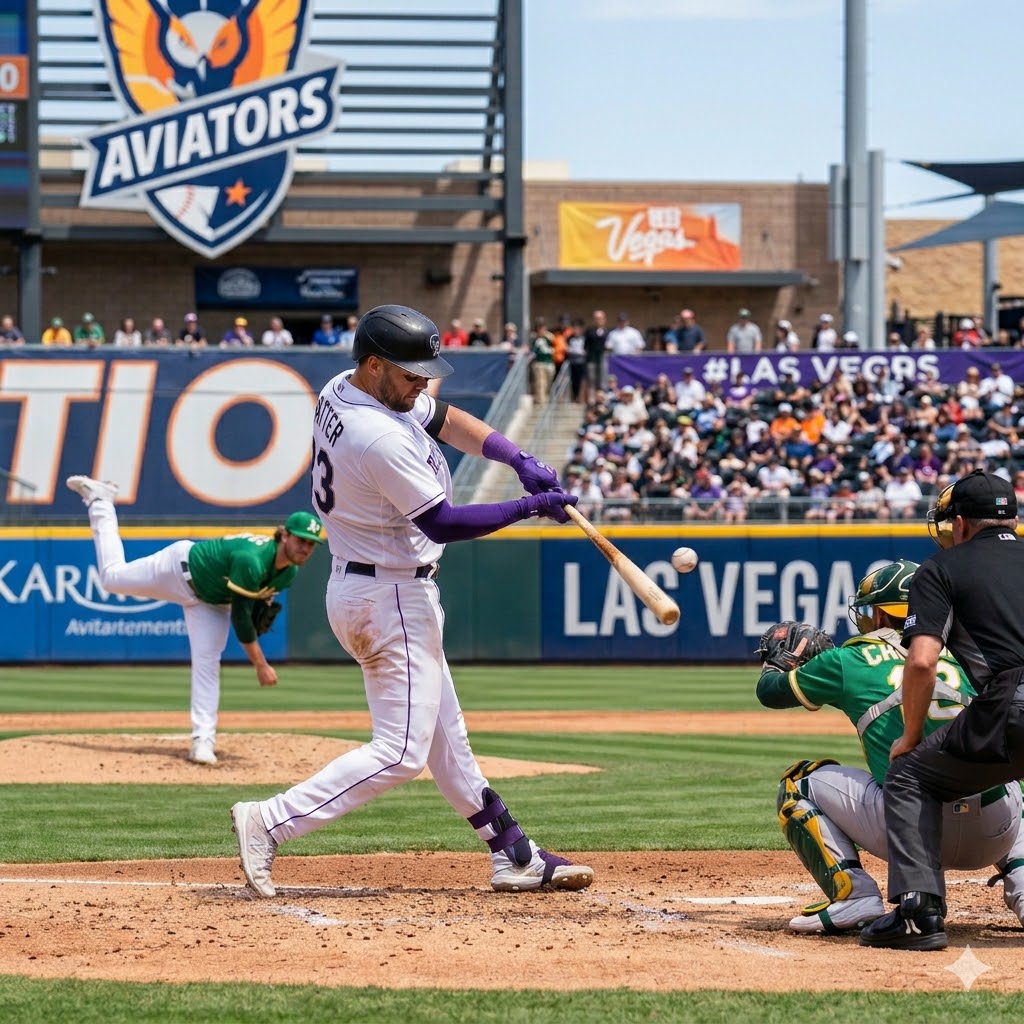
It was 101 degrees at first pitch in Summerlin, Nevada, but the real heat was generated at home plate. On Sunday, June 14, 2026, the Colorado Rockies absolutely dismantled the Athletics in a 23-9 blowout at Las Vegas Ballpark.
While the historic beatdown didn’t quite break the Major League record for combined runs, it completely rewrote the history books for Colorado. The 23 runs marked a new single-game franchise record for the Rockies—a staggering feat for a team that has played more than three decades in the notoriously hitter-friendly altitude of Coors Field.The game quickly devolved into a simulated Home Run Derby, with the two teams combining for 8 long balls. The Rockies blasted 6 of them, fueled by a massive 7-RBI performance from Willi Castro (including an 8th-inning grand slam) and a 5-for-6 day from Hunter Goodman. By the time the dust settled, things had gotten so profoundly out of hand that A’s position player Carlos Cortes was forced to take the mound to pitch the final 1 2/3 innings.Sunday’s game was far from an isolated incident. The A’s brief six-game temporary homestand in Las Vegas (the stadium normally belonging to their Triple-A affiliate) became an absolute nightmare for pitchers. Over just one week against the Brewers and Rockies, teams combined for an eye-popping 102 total runs. The wild week began with a Monday night thriller where Milwaukee outlasted the A’s 15-14 in a 12-inning game featuring 11 home runs. The very next night, Oakland bounced back with a 7-5 win, hitting five home runs of their own. The explosion of runs in Las Vegas can be boiled down to two inescapable factors. Triple-digit June temperatures thin out the air dramatically, turning routine fly balls into carrying deep shots. The second factor being the Triple-A stadium dimensions simply cannot contain elite, modern Major League power when combined with dry desert air.AUnfortunately for Oakland, the scoreboard operator isn't getting a break back in California. While waiting for their permanent Las Vegas stadium to be built for the 2028 season, the A's have spent the majority of their home schedule playing out of another minor league facility: Sutter Health Park in West Sacramento. The results have been remarkably similar. Sutter Health Park features a short 325-foot right-field porch and a tight right-center alley that left-handed batters have been routinely exploiting all season. When the scorching Sacramento valley summer heat spikes into the 90s and 100s, the park plays well above the MLB average for home runs and run-scoring environment. Earlier this season in Sacramento, fans witnessed a 12-10 track meet against the Astros, a 14-6 beating of the Angels, and a lopsided 12-1 blowout against the Phillies.While these high-octane games provide plenty of entertainment for neutral fans and fantasy baseball owners, they have come at a steep cost to the home team. There was a theory that the A's might benefit from playing in tight, cozy environments, but the reality is that visiting teams are the ones padding their stats. Elite opposing lineups come into these minor league environments, lick their chops, and put on absolute clinics. The stark contrast in performance is perfectly captured by Oakland's split records as of mid-June. Playing at home the A's are 15-19 while on the road they are 20-17 and are a genuinely competitive club. When playing in standardized Major League facilities where defensive positioning and traditional pitching metrics matter, they play winning baseball. But the moment they step into their temporary homes, the advantage evaporates.This structural disparity raises a much larger, uncomfortable question for Major League Baseball. Is the A's temporary stadium crisis actively hurting the integrity of the game? In professional baseball, true home-field advantage is built over years by tailoring a 26-man roster to mirror the unique dimensions and atmospheric quirks of a specific ballpark. Because the A's are essentially nomads playing out of temporary minor league venues, they do not have the luxury of constructing a roster specialized for these environments. Instead, they are forced to play standard Major League baseball in ballparks that warp standard outcomes. When routine fly outs turn into multi-run home runs and position players are regularly tossed onto the mound to save exhausted bullpens, the games risk looking less like a premier professional sport and more like an exhibition.The lopsided scoring and warped pitching ERAs underscore a broader competitive imbalance that MLB will have to endure until a permanent, climate-controlled stadium finally opens its doors. Naturally, the biggest victims of this stadium limbo are the members of the A's pitching staff. Oakland's front office has done an admirable job assembling a group of arms that holds its own in standard environments, but their home splits are deeply painful to look at. Good pitching relies on the predictability of a park—knowing that if a pitcher executes a pitch and forces weak contact, the ballpark will reward them with an out. In Sacramento and Las Vegas, perfect pitches are frequently rewarded with a trip around the bases. Bullpens are getting pushed to their absolute limits, starters are seeing their season ERAs balloon in a single afternoon, and the mental tax of knowing a mistake will instantly cost four runs is clearly wearing the staff down.The Athletics' current season is proving to be one of the most bizarre experiments in modern baseball history. While the team shows flashes of brilliant, competitive baseball on the road, their home games have turned into an unpredictable, high-scoring circus. From franchise-shattering 23-run blowouts in the Las Vegas heat to daily slugfests in Sacramento, these minor league venues are rewriting expectations of what an MLB game looks like. For the sake of their pitchers, and the competitive balance of the league, 2028 cannot come soon enough.
While the historic beatdown didn’t quite break the Major League record for combined runs, it completely rewrote the history books for Colorado. The 23 runs marked a new single-game franchise record for the Rockies—a staggering feat for a team that has played more than three decades in the notoriously hitter-friendly altitude of Coors Field.The game quickly devolved into a simulated Home Run Derby, with the two teams combining for 8 long balls. The Rockies blasted 6 of them, fueled by a massive 7-RBI performance from Willi Castro (including an 8th-inning grand slam) and a 5-for-6 day from Hunter Goodman. By the time the dust settled, things had gotten so profoundly out of hand that A’s position player Carlos Cortes was forced to take the mound to pitch the final 1 2/3 innings.Sunday’s game was far from an isolated incident. The A’s brief six-game temporary homestand in Las Vegas (the stadium normally belonging to their Triple-A affiliate) became an absolute nightmare for pitchers. Over just one week against the Brewers and Rockies, teams combined for an eye-popping 102 total runs. The wild week began with a Monday night thriller where Milwaukee outlasted the A’s 15-14 in a 12-inning game featuring 11 home runs. The very next night, Oakland bounced back with a 7-5 win, hitting five home runs of their own. The explosion of runs in Las Vegas can be boiled down to two inescapable factors. Triple-digit June temperatures thin out the air dramatically, turning routine fly balls into carrying deep shots. The second factor being the Triple-A stadium dimensions simply cannot contain elite, modern Major League power when combined with dry desert air.AUnfortunately for Oakland, the scoreboard operator isn't getting a break back in California. While waiting for their permanent Las Vegas stadium to be built for the 2028 season, the A's have spent the majority of their home schedule playing out of another minor league facility: Sutter Health Park in West Sacramento. The results have been remarkably similar. Sutter Health Park features a short 325-foot right-field porch and a tight right-center alley that left-handed batters have been routinely exploiting all season. When the scorching Sacramento valley summer heat spikes into the 90s and 100s, the park plays well above the MLB average for home runs and run-scoring environment. Earlier this season in Sacramento, fans witnessed a 12-10 track meet against the Astros, a 14-6 beating of the Angels, and a lopsided 12-1 blowout against the Phillies.While these high-octane games provide plenty of entertainment for neutral fans and fantasy baseball owners, they have come at a steep cost to the home team. There was a theory that the A's might benefit from playing in tight, cozy environments, but the reality is that visiting teams are the ones padding their stats. Elite opposing lineups come into these minor league environments, lick their chops, and put on absolute clinics. The stark contrast in performance is perfectly captured by Oakland's split records as of mid-June. Playing at home the A's are 15-19 while on the road they are 20-17 and are a genuinely competitive club. When playing in standardized Major League facilities where defensive positioning and traditional pitching metrics matter, they play winning baseball. But the moment they step into their temporary homes, the advantage evaporates.This structural disparity raises a much larger, uncomfortable question for Major League Baseball. Is the A's temporary stadium crisis actively hurting the integrity of the game? In professional baseball, true home-field advantage is built over years by tailoring a 26-man roster to mirror the unique dimensions and atmospheric quirks of a specific ballpark. Because the A's are essentially nomads playing out of temporary minor league venues, they do not have the luxury of constructing a roster specialized for these environments. Instead, they are forced to play standard Major League baseball in ballparks that warp standard outcomes. When routine fly outs turn into multi-run home runs and position players are regularly tossed onto the mound to save exhausted bullpens, the games risk looking less like a premier professional sport and more like an exhibition.The lopsided scoring and warped pitching ERAs underscore a broader competitive imbalance that MLB will have to endure until a permanent, climate-controlled stadium finally opens its doors. Naturally, the biggest victims of this stadium limbo are the members of the A's pitching staff. Oakland's front office has done an admirable job assembling a group of arms that holds its own in standard environments, but their home splits are deeply painful to look at. Good pitching relies on the predictability of a park—knowing that if a pitcher executes a pitch and forces weak contact, the ballpark will reward them with an out. In Sacramento and Las Vegas, perfect pitches are frequently rewarded with a trip around the bases. Bullpens are getting pushed to their absolute limits, starters are seeing their season ERAs balloon in a single afternoon, and the mental tax of knowing a mistake will instantly cost four runs is clearly wearing the staff down.The Athletics' current season is proving to be one of the most bizarre experiments in modern baseball history. While the team shows flashes of brilliant, competitive baseball on the road, their home games have turned into an unpredictable, high-scoring circus. From franchise-shattering 23-run blowouts in the Las Vegas heat to daily slugfests in Sacramento, these minor league venues are rewriting expectations of what an MLB game looks like. For the sake of their pitchers, and the competitive balance of the league, 2028 cannot come soon enough.